
Overview
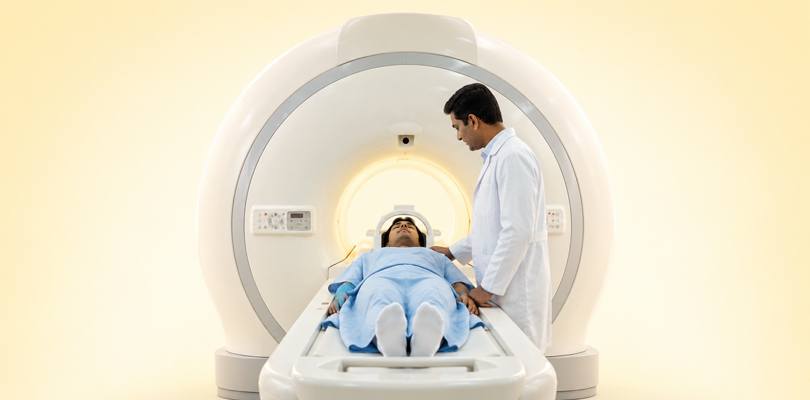
At Lilavati Hospital, Gujarat, MRI is an imaging technique that uses strong magnetic fields and radio waves to produce detailed 3D images of internal structures. MRI does not use radiation, unlike CT scans or X-rays. It is especially helpful for visualizing soft tissues such as the brain, spinal cord, joints, muscles, and internal organs. The scanner is a big machine that looks like a tunnel. The process involves taking many pictures and combining them to create very detailed views. A contrast agent is sometimes used to enhance images and highlight specific areas. MRI is highly regarded for its accuracy, particularly in intricate or nuanced conditions.
MRI doesn't treat conditions; it's a very useful diagnostic tool. It helps find a lot of different problems, such as brain tumors, strokes, multiple sclerosis, spinal cord disorders, joint injuries, and soft tissue problems. It is also used to assess the heart's structure, liver function, and pelvic problems. Doctors often use MRI to monitor known diseases and plan treatment. In some cases, it helps with image-guided procedures where accuracy is very important.
MRI has become a key part of modern diagnostic medicine because it can produce detailed images without exposing patients to radiation. Technology has made scans faster and images clearer, making the process more comfortable and efficient. MRI helps doctors find the right treatment by making an early and accurate diagnosis. This leads to better overall patient outcomes.